Judge Not (part one)

1) It is quite common to hear people say, “The Bible says, ‘Judge not’, so you can’t judge anybody. Only God can judge.” Is it really true that no one is allowed, Scripturally speaking, to judge another’s action? The idea of “Judge not” is, definitely, a biblical couch, but most of the people from whom I have heard this clause quote it out of context. Unless you have absolute access into my mind, you definitely cannot know what next, I want to say. You have to wait for the conclusion. Verse one of Matthew chapter 7 is, number one, the preamble to what Jesus actually wanted to enrich man’s faculty of understanding with. Number two, verse one is not the conclusion; the concluding wholesomeness of this teaching is in the second verse. Half truths can be dangerously misleading.
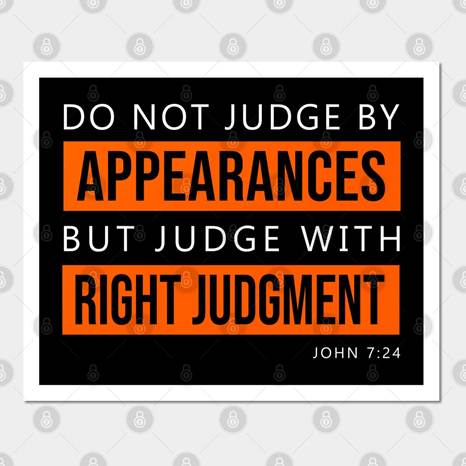
So, let me take us through the wholeness of the Lord’s didacticism. “Judge not, that ye be not judged. 2) For with what judgment ye judge, ye shall be judged: and with what measure ye mete, it shall be measured to you again” (Matthew 7:1-2). The word ‘judge’ is krinō (kree’-no) – in this context – ‘to judge crooked judgments, i.e. to judge unjustly; to judge him by myself.’ Now, if, as many believe and teach, we cannot judge others at all, how morally or scripturally am I when I cry out, “Armed robber”, pointing to the one who puts a knife to my throat and robs me of all the contents of my pocket: for I have placed a judgement on his thieving act? The word ‘judgement’ of the second verse is krima (kree’-mah), the noun form of krinō. True contextual paraphrase of the two verses is like this: “Do not tag another with rash criticism, in order not to deserve sharp criticism. Because the degree of your wrong judgement will your criminality be.” We always forget that verse one does not stand alone. It is only complete in the next verse two. Jesus is, from this part of the long Sermon on the Mount, warning against censoriousness. “Don’t judge” is one of the didactic faux pas that thrives unnecessarily, and quite disappointingly, on various pulpits.
“Shall not the Judge of all the earth do right” (Genesis 18:25)?
Scriptural facticity points to righteous and unrighteous judgements. In his, face to face, discourse with the LORD God, Abraham said, “That be far from thee to do after this manner, to slay the righteous with the wicked: and that the righteous should be as the wicked, that be far from thee: Shall not the Judge of all the earth do right” (Genesis 18:25)? Even though the LORD’s accepted Abrahamic bargain of ten righteous souls were not found, the grace of God’s righteousness saved the only four members of one family from the Sodom and Gomorrah annihilation.
Prophet Isaiah captured a glimpse of Messianic millennial reign of righteousness in Isaiah 11:3-4 3) “And shall make him of quick understanding in the fear of the LORD: and he shall not judge after the sight of his eyes, neither reprove after the hearing of his ears: 4) But with righteousness shall he judge the poor, and reprove with equity for the meek of the earth: and he shall smite the earth with the rod of his mouth, and with the breath of his lips shall he slay the wicked.” Another Messianic vaticination of Davidic pen is Psalm 98:8-9 8) “Let the floods clap their hands: let the hills be joyful together 9) Before the LORD; for he cometh to judge the earth: with righteousness shall he judge the world, and the people with equity.”
Pauline exhortation to Athenians did not fail to inculcate righteous judgement in Acts of the Apostles 17:31 “Because he hath appointed a day, in the which he will judge the world in righteousness by that man whom he hath ordained; whereof he hath given assurance unto all men, in that he hath raised him from the dead.” There are not three types of judgements. There are only two and they are righteous and unrighteous judgments.
Divine decree concerning justice was given to the people of God through the mouth of Moses in Leviticus 19:15 “Ye shall do no unrighteousness in judgment: thou shalt not respect the person of the poor, nor honour the person of the mighty: but in righteousness shalt thou judge thy neighbour.” From this verse, ‘unrighteousness’ is the English word for the Hebrew ‛evel (eh’-vel): ‘violent deeds of injustice, evil.’ The next word, ‘judgment’ is mishpâṭ (mish-pawt’): ‘a verdict (favorable or unfavorable) pronounced judicially, especially a sentence or formal decree (human or (particularly) divine law.’ ‘Righteousness’ is tsedeq (tseh’-dek): ‘rightness; the right (natural, moral or legal); also (abstractly) equity.’ The verb ‘judge’ is shâphaṭ (shaw-fat’): ‘to judge, govern, vindicate, punish.’ It is clear from this verse that there are only two types of judgement and from Mosaic utterance, it is a verbal act of human application. The words ‘poor’ and ‘mighty’ are statuses of extremities; whether the person is extremely poor or extremely important, judgement to either must show indubitable equity.

Come to JESUS for regeneration.
To get born again, say, believing every word of it, this prayer:
“Dear heavenly Father, I come to You now in the name of Jesus Christ. I believe in my heart that Jesus is the Son of God. I believe that Jesus died on the cross for my sin. I believe that You raised Him from the dead. I confess with my mouth that Jesus is Lord and I receive Him now as my Lord and my Saviour. I give God all the glory. Amen!”
(…to be continued…)
Get the previous post here.
Get part one. Click.