Judge Not (part two)

(…continues from part one…)
2) Asaph, a chief Levite musician under David, through Divine inspiration wrote Psalm 82:2 “How long will ye judge unjustly, and accept the persons of the wicked? Selah.” Asaph points out against perversion of justice. 2Chronicles 19:6 “And said to the judges, Take heed what ye do: for ye judge not for man, but for the LORD, who is with you in the judgment.” The word ‘judgment’ of this verse comes from two words: dâbâr (daw-baw’): ‘speech, word, speaking, thing’ and mishpâṭ (mish-pawt’) ‘properly a verdict (favorable or unfavorable) pronounced judicially.’ The sooth is, the free moral agency of Adam’s making gives mankind the Divine constitutional right to judge between right and wrong when we read of the dictum: 16) “And the LORD God commanded the man, saying, Of every tree of the garden thou mayest freely eat: 17) But of the tree of the knowledge of good and evil, thou shalt not eat of it: for in the day that thou eatest thereof thou shalt surely die” (Genesis 2:16-17). The LORD God, placing a clear distinction between right and wrong, blesses humanity with the wisdom to vindicate the righteous actor and to condemn unrighteous deed.
I have always maintained that, “If I see you, and hear you do a thing, I’ll judge you.” When I see two unmarried male and female in active coition, my judgment is simple, “You have committed the sin of fornication.” You entered another person’s apartment and you came out with the owner of the apartment’s phone, and the person asked, “Who made an entrance into my flat,” wanting to know who had taken his phone and you keep mum. I ask you what you went there for, and you brazenly tell me, “I didn’t go there;” I will call you a thief. Why? I saw you when you entered and when you walked out pocketing the phone which you and I know is not yours. If you happen to be seated by me in a public transport and receiving a phone call, you tell the caller, “I am standing at the Local Government Council Chairman’s door; call me in two hours’ time,” I will judge your act, and call you, “A liar!” I will judge you when I see you and hear you loudly and clearly; and I will not be running into any misbehaviour because my judgment is not a rash one.
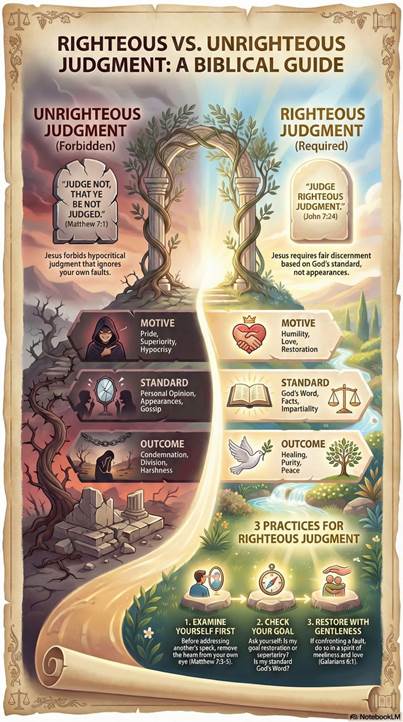
Unrighteous judgment is presented in the Bible. Exodus 23:2-3 2) “Thou shalt not follow a multitude to do evil; neither shalt thou speak in a cause to decline after many to wrest judgment: 3) Neither shalt thou countenance a poor man in his cause.” The word ‘wrest’ is nâṭâh (naw-taw’): ‘to stretch out, extend, spread out, pitch, turn, pervert.’ The word ‘countenance’ is hâdar (haw-dar’): ‘honour, glorify or favour.’ God is telling us never to bend judgment to show partiality even towards a poor person. God told Israel in Leviticus 19:15 “Ye shall do no unrighteousness in judgment: thou shalt not respect the person of the poor, nor honour the person of the mighty: but in righteousness shalt thou judge thy neighbour.” This is what we should be talking about: unrighteous judgment. We can judge as long as it is in strictness of righteousness.
When it comes to adjudication Moses told Israel in Deuteronomy 1:17 “Ye shall not respect persons in judgment; but ye shall hear the small as well as the great; ye shall not be afraid of the face of man; for the judgment is God’s: and the cause that is too hard for you, bring it unto me, and I will hear it.” Would Moses had told Israel, “Ye shall not respect persons in judgment”, if it is wrong to judge? There is not a doubt that Jehovah is the ultimate Judge; we do know, nevertheless, that humans have the propensity to judging in wrongness. It is in this light that God, through the pen of the Psalmist, wrote the comminatory lyrics, “How long will ye judge unjustly, and accept the persons of the wicked? Selah” (Psalm 82:2). Is this verse pointing to the commination of human judgment or the righteous tenor of adjudication? Clearly what Psalm 82 is doing is not outright condemnation of human judgment, but the peccancy involved in unrighteous hue of justice. The Book of Apostle James puts it more succinctly and forceful, “But if ye have respect to persons, ye commit sin, and are convinced of the law as transgressors” (James 2:9). Law of the Divinity frowns, not at mere ventilation of judgment, but the perversion of it.

To get born again, say, believing every word of it, this prayer:
“Dear heavenly Father, I come to You now in the name of Jesus Christ. I believe in my heart that Jesus is the Son of God. I believe that Jesus died on the cross for my sin. I believe that You raised Him from the dead. I confess with my mouth that Jesus is Lord and I receive Him now as my Lord and my Saviour. I give God all the glory. Amen!”
(…to be continued…)
Read part one here
Get part three. Click.